- May 26, 2026
- 16 min read
What Is KYC? A Complete Guide to Know Your Customer Verification
KYC verification explained: learn how Know Your Customer compliance works, including key steps, verification types, global regulations, and best practices for 2026.


Know Your Customer (KYC) is a crucial line of defense for both regulated and non-regulated businesses. Weak verification practices can expose platforms to financial crime and money-laundering risks and, for AML-obliged businesses, lead to substantial penalties from regulators.
A recent example came in January 2026, when Denmark’s Financial Supervisory Authority fined Saxo Bank DKK 313 million (approx. USD 49 million) for breaches of Denmark’s Money Laundering Act.
Importantly, the inspection found no actual instances or signs of money laundering, but structural control failures led to a significant fine.
The case demonstrates that KYC is more complex than checking a customer’s identity at onboarding. It requires businesses to understand customer relationships, assess risk, and monitor activity throughout the customer lifecycle.
This article explores what KYC verification involves, how expectations are changing, and the key regulations businesses need to follow to stay compliant.
What is KYC verification?
Know Your Customer (KYC) verification is the process of identifying customers, verifying they are who they claim to be, and assessing the level of risk they may present before allowing the customer to access certain products or services. It is crucial for both regulated and non-regulated businesses because it helps prevent criminals from using legitimate platforms to hide, move, or spend illicit funds.
KYC verification may involve document checks, biometric checks, database verification, proof of address, sanctions and watchlist screening, risk scoring, and ongoing monitoring.
The exact process depends on the business model, jurisdiction, and level of risk posed by the customer.
KYC meaning and purpose
KYC means "Know Your Customer"—a process designed to help businesses understand who their customers truly are.
With an estimated 2 to 5% of global GDP linked to money laundering, governments impose strict anti-financial-crime obligations on high-risk industries. KYC serves as a first line of defense by helping businesses verify customer identities, assess risk, prevent fraud, and reduce the likelihood of criminals accessing financial services through their platforms.
These risks are growing in scale and complexity. Sophisticated fraud schemes have surged in recent years, making robust customer verification more critical than ever.
A standard KYC process begins with the collection of customer identity information, followed by its verification. Traditionally, this meant checking identity documents and confirming proof of address through utility bills or similar records. Many businesses now complement or replace these methods with digital tools—biometric checks, NFC chip reading, and government database lookups—allowing faster and more reliable verification at scale.
Why KYC matters for businesses
For regulated businesses, KYC is a core part of AML compliance. Banks, fintechs, crypto platforms, and gambling operators, for example, are required to identify customers, understand the nature of the relationship, assess risk, and monitor for suspicious activity.
Strong KYC controls help these firms prevent financial crime and also help demonstrate to regulators that the business has appropriate controls in place, reducing the risk of regulatory penalties.
For non-regulated businesses, such as carsharing, telecom, dating, and marketplaces, KYC is not a legal obligation, yet it is still extremely important. Identity checks help companies avoid dealing unknowingly with fraudsters, sanctioned individuals, or other bad actors. This protects legitimate customers, limits reputational damage, and builds trust with customers and partners. It can also prepare businesses for future regulatory expectations as financial crime rules continue to expand into new sectors.
Suggested read: KYC vs AML: Complete Global Guide to Key Differences and Best Practices
Key components of KYC compliance
The exact requirements vary by jurisdiction and industry, but effective KYC compliance is built around three core processes: identifying and verifying the customer, understanding the risk they pose, and monitoring whether their activity remains consistent over time.
Customer identification and verification
Customer identification is the first stage of the KYC process. This involves collecting information that allows a business to identify a customer before starting a customer relationship.
This may include:
- Full name
- Date of birth
- Residential address
- Nationality
- Government-issued ID number
The next step, customer identity verification, checks that the information provided by the customer is accurate and belongs to a real person.
Traditional KYC identity verification relies on identity documents, such as passports, while digital KYC may also use biometric checks, liveness detection, NFC chip reading, database checks, and other electronic verification methods.
Customer due diligence and enhanced due diligence
Customer due diligence is the process of assessing the risk a customer may present after their identity has been established. It helps businesses understand who the customer is, why they want to use a product or service, and whether their expected activity makes sense.
CDD may involve collecting and assessing information such as:
- The customer’s occupation or business activity
- Source of funds or wealth
- Purpose and intended nature of the relationship
- Expected transaction patterns
- Geographic risk
- Links to politically exposed persons, sanctions, or adverse media
Higher-risk customers, such as politically exposed persons or those from high-risk jurisdictions, may require enhanced due diligence (EDD), which involves more in-depth, tailored checks.
Suggested read: Enhanced Due Diligence
Ongoing monitoring and periodic reviews
KYC does not end once a customer has been onboarded. Businesses need ongoing monitoring to ensure that customer information remains accurate and that activity continues to match the customer’s expected risk profile.
This may include transaction monitoring, updates to customer documents, and repeated AML screening against sanctions lists, PEP databases, adverse media, and other relevant watchlists. AML screening is especially important for regulated businesses because it helps them detect whether a customer has become sanctioned, politically exposed, or otherwise higher risk after onboarding.
Rule-based periodic reviews at defined intervals are important for keeping records up to date. A low-risk customer may be reviewed less frequently, while a high-risk customer may require more regular reassessment, helping businesses identify changes that could affect risk.
Automated perpetual KYC checks can help continuously update customer profiles. This can help compliance teams identify changes faster, reduce manual workload, and maintain a more accurate view of customer risk throughout the entire lifecycle.
Suggested read: AI Fake IDs and the New KYC Risk
Types of KYC verification methods
Businesses may use different KYC verification methods depending on their industry, jurisdiction, and customer risk level. Some companies still rely on manual document checks, while others use digital KYC tools to verify identities remotely and automate more of the compliance workflow.
Regulated businesses tend to use a layered approach, combining different verification methods to assist compliance and reduce fraud risks.
Traditional KYC
Traditional KYC typically relies on in-person manual checks, in which a customer provides identity documents, proof of address, and any other information required under local regulations.
This approach still has its place, particularly in branch-based banking, high-risk onboarding, and situations where regulations require human review. However, it becomes unreliable when it depends too heavily on manual inspection or outdated fraud rules.
That vulnerability is sharpening. AI-generated fake IDs have reached a level of realism that can convincingly pass traditional KYC checks. What once required specialist skills and significant resources can now be produced for as little as $20 in under half an hour, which allows fraudsters to bypass legacy verification controls at scale.
As onboarding moved online, many businesses replaced in-person document submission with upload-based verification—a convenient solution, but one that introduced new vulnerabilities. Upload-only verification is especially exposed, since it offers no reliable proof that a document was captured live, on a real device, by the person being onboarded.
Stronger controls can address these gaps: document forensics, biometric matching with liveness detection, and risk scoring all add meaningful layers on top of traditional checks.
Meanwhile, even conventional banking is moving toward digitalized workflows, with on-premises liveness checks conducted on tablets now in use across several markets.
Digital KYC and eKYC
Digital KYC and eKYC (electronic KYC) are often used interchangeably, although the exact meaning can vary by context and jurisdiction. Both refer to verifying a customer’s identity online using methods such as identity document checks and biometric verification. Digital KYC removes the need for in-person verification, making onboarding faster, more accessible, and easier to scale.
Digital KYC may include:
- Online identity document checks
- Liveness detection
- Sanctions, PEP, and watchlist screening as part of AML checks
- Risk scoring
- Automated case management
The main advantage of digital KYC is that it can accelerate onboarding and scale more easily, at the same time supporting compliance. Instead of relying on manual review for every applicant, businesses can automate lower-risk checks and route suspicious or high-risk cases to compliance teams.
Document-free verification
Document-free verification allows businesses to verify a customer without asking them to upload an identity document. Instead, systems can check customer data against trusted sources, such as government databases or credit bureau records, depending on the country and legal framework. In India, for instance, the Aadhaar unique identity number system can be used for document-free verification.
Authentication is typically performed via biometrics or one-time passwords (OTPs), enabling fast, real-time onboarding. This method is more common in countries with centralized identity systems and strong digital infrastructure.
This form of automated KYC verification can reduce friction for legitimate users because they do not need to photograph documents or manually submit proof of address. It can also help businesses onboard customers in markets where database coverage is strong, and regulations allow non-documentary checks.
Video KYC
Video KYC uses a live or recorded video to verify a customer remotely. In a live video system, a trained operator may ask the customer to show their identity document, answer questions, or perform simple actions to prove that they are physically present, adding a human layer of verification to remote onboarding.
In Germany, BaFin permits the video identification process as one of the limited KYC methods and imposes detailed requirements for video KYC, including real-time video interaction and verification by appropriately trained staff.
In an automated system, video may be combined with biometric checks, liveness detection, and enhanced document verification.
Automated KYC
Automated KYC uses automation to handle parts of the KYC process that would otherwise require manual review. This can include document scanning, OCR, document authenticity and validity check, liveness detection, risk scoring, and routing cases to senior reviewers.
Good KYC software can help businesses reduce onboarding time, detect fraud signals, and keep audit trails for compliance teams. It can also support a risk-based approach by allowing low-risk customers to pass through faster while escalating higher-risk customers for enhanced due diligence.
NFC verification
NFC verification uses near-field communication to read data from the chip embedded in biometric identity documents, such as passports. The customer taps their document against an NFC-enabled device, such as a smartphone, allowing the system to read the chip data and compare it with the information printed on the document.
NFC can provide a stronger identity verification signal than visual inspection alone because chip data is harder to tamper with than a document image. It can help confirm that the document is genuine, that the data has not been altered, and that the document belongs to the person being verified.
How does the KYC process work?
The KYC process is designed to confirm that a customer is who they claim to be, assess the risk they may present, and determine whether the business can safely provide access to its services.
A typical KYC flow includes customer identification, document or database verification, biometric checks, AML screening, proof of address, risk scoring, and ongoing monitoring. The exact steps depend on the customer, jurisdiction, product, and risk level.
Step-by-step KYC onboarding flow
The KYC onboarding process may vary depending on the business, jurisdiction, and customer risk level, but it usually includes the following steps:
- Customer identification: The business collects basic information about the customer.
- Identity verification: The customer’s identity is checked using reliable evidence. This may involve ID verification, where identity documents are checked, or non-document verification, where customer data is cross-checked against trusted databases in supported countries.
- Liveness and biometric checks: The customer may be asked to take a selfie or complete a liveness check to confirm that they are a real person.
- Address verification: Where required, the business verifies the customer’s residential address using proof-of-address documents, databases, or geolocation-based methods.
- AML screening: The customer is screened against sanctions lists, politically exposed person databases, adverse media sources, and other global watchlists to identify potential financial crime risks.
- Questionnaires and additional data collection: Some businesses collect extra information through questionnaires to assess risk.
- Risk scoring: The business assigns a risk level based on the customer’s information. Higher-risk customers may require enhanced due diligence.
- Approval, rejection, or manual review: Low-risk customers may be approved automatically, while higher-risk cases may be sent to compliance teams for manual review.
KYC does not stop once onboarding is over. Businesses need to keep records up to date and monitor for activity that does not match the customer’s expected profile.
Liveness check and biometric authentication
A liveness check helps confirm that the person completing customer onboarding is real, present, and not using a static photo, a stolen image, a mask, a deepfake, or a pre-recorded video. As deepfakes continue to advance, it is crucial to use a liveness check that can distinguish fact from fiction.
In a typical digital KYC flow, the customer may be asked to take a selfie, turn their head, blink, follow on-screen instructions, or perform another action to verify physical presence. The system can then compare the customer’s face with the image on their identity document or digital identity record.
Biometric authentication, such as facial or fingerprint recognition, adds another layer of protection by verifying that the person presenting the identity evidence matches the legitimate document holder.
AML screening: PEP and sanctions checks
AML screening helps businesses identify customers who may present financial crime risks.
Sanctions screening checks whether a customer appears on national or international sanctions lists. These checks are important because businesses may be prohibited from serving sanctioned individuals, depending on the applicable laws.
PEP screening checks whether a customer is a politically exposed person (PEP) or closely connected to one. PEP status does not automatically mean a customer cannot use the services, but risk mitigation is important. As a result, PEPs generally require enhanced due diligence.
AML screening may also include adverse media checks and checks against high-risk jurisdictions.
Suggested read: How to Stay Ahead of Deepfake Evolution in 2026
KYC requirements by industry
In general, any business covered by AML regulations must identify and verify its customers, assess risk, conduct due diligence, and monitor activity over time. The strictest KYC requirements, however, usually apply to financial services like banks.
Other regulated sectors include fintechs, payment providers, crypto businesses, trading platforms, and gambling operators.
Nevertheless, customer identity verification is increasingly used in non-regulated or less-regulated industries, such as transport platforms and e-commerce businesses, where fraud, account abuse, and money-mule activity still pose serious risks.
Banking, fintech, and neobanks
KYC requirements for banks are among the strictest because banks sit at the center of the financial system. Banks must verify customer identities, understand the purpose of customer relationships, assess money-laundering and terrorist-financing risk, monitor transactions, and keep customer records up to date.
Fintechs and neobanks often face similar KYC obligations, especially when they offer payments, lending, investment products, or other regulated financial services.
A strong KYC process for banks, fintechs, and neobanks should combine identity verification, fraud detection, AML screening, risk scoring, and ongoing monitoring. Higher-risk customers may require enhanced due diligence, while lower-risk customers can often move through a faster, risk-based onboarding flow.
Crypto, trading, and gambling platforms
KYC requirements for companies in the crypto sector have become stricter as regulators have expanded traditional AML rules to apply to virtual asset service providers, exchanges, wallet providers, and other crypto-related businesses.
Depending on the jurisdiction, crypto platforms may need to identify and verify customers, screen wallets and users, monitor transactions, report suspicious activity, and apply enhanced checks to higher-risk customers.
Trading platforms also need strong KYC controls because they are exposed to market abuse, mule accounts, fraud, and money laundering. KYC helps these businesses understand who is trading, where funds come from, and whether account activity matches the customer’s profile.
Gambling and betting platforms face risks such as bonus abuse, underage gambling, self-exclusion violations, and money laundering. KYC checks help operators verify age, identity, location, and risk level before allowing customers to access restricted services.
Suggested read: Bonus Abuse in Gambling: Types, Risks & How to Prevent
KYC regulations around the globe
While KYC regulations vary by country, most frameworks share the same basic aim of preventing businesses from being used for money laundering, terrorist financing, sanctions evasion, fraud, and other financial crimes.
In practice, AML regulations require businesses to identify and verify customers, understand the purpose of customer relationships, assess risk, screen against relevant lists, keep records, and monitor activity over time. However, the specific checks, sources, reporting duties, and review periods vary across jurisdictions.
Global KYC rules are also becoming more demanding as regulators adapt to cross-border financial services, widespread adoption of crypto assets, AI-driven identity fraud, and complex ownership structures, making an understanding of the changing global regulatory landscape essential for international businesses, especially in regulated sectors.
FATF recommendations and risk lists
The Financial Action Task Force (FATF) sets international standards for combating money laundering, terrorist financing, and proliferation financing. While the FATF recommendations are not laws, they strongly influence national AML and KYC rules around the world, and help provide a more uniform global framework to combat financial crime.
FATF’s standards cover areas such as customer due diligence, beneficial ownership transparency, money or value transfer services, virtual assets, suspicious transaction reporting, and the risk-based approach. Countries are assessed against these standards through “mutual evaluations,” which review compliance and the effectiveness of national AML/CFT systems.
FATF also publishes lists of high-risk jurisdictions and jurisdictions under increased monitoring. The increased monitoring list is often called the “grey list.” These lists are important for KYC processes because customers linked to higher-risk jurisdictions may require additional controls.
EU: AMLA, 6AMLD, and AMLR
The EU has introduced a major AML/CFT reform package, known as the EU AML Package, designed to make supervision and enforcement more consistent across its member states. This includes the creation of the Anti-Money Laundering Authority (AMLA) as well as the AML Regulation (AMLR) and the Sixth Anti-Money Laundering Directive (6AMLD).
The AMLR (Regulation (EU) 2024/1624) is intended to harmonize core AML/CFT obligations for obliged entities across the EU, while 6AMLD (Directive (EU) 2024/1640) focuses on national supervisory systems and how member states implement parts of the AML/CFT framework.
The EU is moving toward more harmonized rules on customer due diligence, risk assessment, supervision, sanctions implementation, and beneficial ownership transparency.
This means businesses operating in the EU need to adapt to Europe’s changing KYC landscape.
APAC and other jurisdictions
Across APAC and other major markets, KYC rules continue to evolve in response to changes in digital finance, virtual assets, cross-border payments, and rising rates of financial crime.
Singapore, for example, applies detailed AML/CFT requirements to digital payment token service providers through MAS Notice PSN02, including customer due diligence, screening, suspicious transaction reporting, recordkeeping, and controls for wire and value transfers.
Hong Kong’s SFC, meanwhile, has established a licensing and supervisory framework for virtual asset trading platforms, with requirements covering Know Your Customer processes, AML/CFT controls, custody, risk management, cybersecurity, and market abuse prevention. Under Hong Kong’s AMLO, SFC-licensed virtual asset service providers are also subject to customer due diligence and recordkeeping obligations.
India has developed digital onboarding models through the RBI-recognized Video-based Customer Identification Process (V-CIP), which allows regulated entities to verify customers remotely through live audio-visual interaction and through the Aadhaar-based digital identity infrastructure.
Across Latin America, AML and KYC frameworks are also evolving quickly, particularly in response to the growth of digital payments, fintech, and virtual assets. Brazil and Mexico, for instance, have both strengthened oversight in their wider financial systems. There is a clear worldwide trend of regulators bringing more digital finance activity within the AML/KYC perimeter.
Globally, there is a move toward tighter customer due diligence, stronger screening, more robust monitoring, and greater regulatory pressure on businesses.
Suggested read: How to Check if a Company is Legit in 2026
What is KYB verification?
Know Your Business (KYB) verification is the process of identifying and verifying that a company is legitimate before entering into a business relationship with it. KYB involves verifying a business’s structure, ownership (including the ultimate beneficial owner), and what it actually does. KYB helps uncover shady setups that might be hiding fraud or money laundering, giving businesses a clearer picture of who they are partnering with.
KYB is especially important for banks, fintechs, payment providers, marketplaces, crypto platforms, and other businesses that onboard corporate customers or merchants. Without suitable business verification, companies may unknowingly serve shell companies, sanctioned entities, or businesses being used to hide the identity of criminal actors.
Verifying ultimate beneficial owners
A key part of KYB is identifying and verifying ultimate beneficial owners (UBOs). These are the individuals who ultimately own or control a company, even if their names do not appear in the day-to-day business relationship.
A company may appear legitimate on paper while being owned or controlled by a sanctioned person, a politically exposed person, a fraud network, or a money-laundering operation.
To verify UBOs, businesses may need to collect and review company registry data, shareholder records, ownership charts, corporate documents, and information about control rights.
Suggested read: KYB (Know Your Business) Verification Guide 2026
The cost of KYC non-compliance
If a business fails to verify customers correctly, understand customer relationships, monitor activity, or escalate suspicious behavior, it may breach AML compliance obligations and expose itself to regulatory enforcement.
KYC non-compliance can lead to heavy fines, business restrictions, remediation orders, criminal investigations, reputational damage, and closer scrutiny from regulators, banking partners, investors, and customers. In serious cases, firms may also face limits on growth, restrictions on certain business lines, or loss of license.
The regulatory direction is also becoming stricter. For compliance teams, 2026 is expected to be a particularly regulation-heavy year, with firms preparing for new or updated AML, digital finance, crypto, payments, and operational resilience requirements worldwide.
Recent AML fines and enforcement trends
Recent enforcement actions around the world show that regulators are focusing closely on whether firms are responding appropriately to risks.
Germany’s BaFin also imposed a record €45 million ($53 million) fine on J.P. Morgan SE in 2025 for systematic delays in filing suspicious activity reports between October 2021 and September 2022. The case shows that enforcement is not limited to onboarding failures, as late escalation and reporting can create major AML exposure.
In Asia, Singapore’s MAS imposed S$27.45 million (approx. US$21.64 million) in penalties on nine financial institutions in July 2025 for AML/CFT breaches. The regulator cited weaknesses, including inadequate customer due diligence, insufficient source-of-wealth corroboration, failure to properly investigate red flags, and delays in reporting suspicious transactions.
For AML compliance officers, these cases underscore the same lesson: regulators expect KYC controls to be risk-based, compliant, well-documented, and effective in combating the significant risks of financial crime.
KYC best practices for 2026
Effective KYC and AML programs need to be risk-adaptive, harmonized, technology-driven, and ongoing, able to respond quickly to new fraud tactics and regulatory expectations, with a focus on automation and staying up to date with evolving KYC obligations.
Static onboarding checks are no longer enough, especially as advancements in AI make trust harder to establish in complex customer relationships and regulators act urgently in response to escalating reports of financial crime.
AI, automation, and behavioral analytics
AI and automation can help businesses process high volumes of customer checks more efficiently. Automated KYC verification can help in document reading, data extraction, authenticity checks, biometric matching, liveness detection, sanctions screening, risk scoring, and case routing.
This reduces workload, reduces manual errors, and helps compliance teams focus on higher-risk cases that require expert human judgment.
Behavioral analytics add another layer of protection by looking at how users behave across key platform events, such as sign-ups, logins, verification sessions, password changes, account settings updates, and attempts to disable security controls. These signals can help detect bots, fraud rings, account takeover attempts, mule activity, or unusual customer behavior that may require closer review.
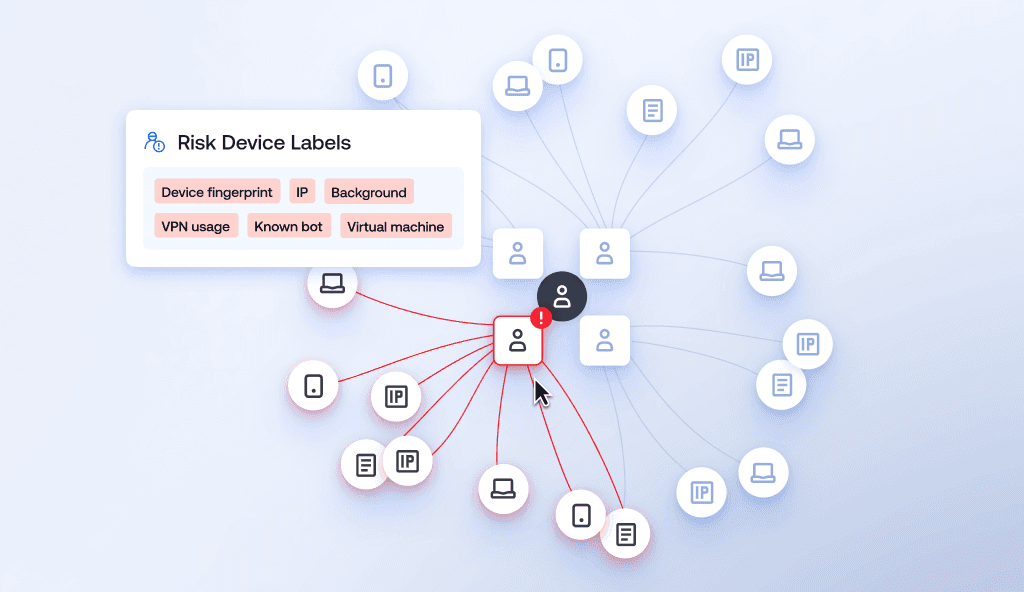
Device intelligence is also becoming an important part of KYC and fraud prevention. By assessing device fingerprinting, IP risk, geolocation consistency, and repeated device activity across accounts, businesses can detect suspicious patterns that identity documents alone may miss.
Perpetual KYC and agile compliance workflows
Perpetual KYC means moving away from one-time onboarding checks and toward continuous or event-triggered customer review. Instead of waiting for a fixed review date, businesses can update customer profiles when new information becomes available or when risk signals change.
Automated triggers for review may include:
- Expired identity documents
- Changes in customer activity
- Unusual transaction behavior
- New sanctions, PEP, or adverse media matches as part of AML screening
- Changes in business ownership or control
- Movement into higher-risk jurisdictions
- Inconsistent source-of-funds information
This supports stronger KYC and AML compliance because a low-risk customer at onboarding may become higher risk later, while outdated records can make it harder for businesses to explain decisions during audits or regulatory reviews.
Agile compliance workflows help teams respond quickly to these changes.
Businesses should also keep clear, auditable records of KYC decisions, as strong documentation helps demonstrate that the company’s controls are working in practice.
How to choose the best KYC software
The best KYC software covers all the KYC needs a business has to comply with its regulatory obligations.
The key criteria for choosing a KYC provider include:
- Compliance. The solution must be compliant with the regulatory requirements of the business’s jurisdiction(s). For example, if the business is registered in Austria, its KYC provider must be able to conduct video interviews in accordance with Austrian regulations.
- Fraud prevention. Providers should offer strong AI-powered anti-fraud protection that detects forgeries, spoofing, and other malicious activity.
- Flexibility. Businesses should be able to create customizable verification flows for different products and customers.
- Coverage. This means support for document types from different countries.
- Language support. The solution should have different languages for its interface, as well as OCR (Optical Character Recognition) technology that can recognize non-Latin characters, such as Chinese, Japanese, or Cyrillic scripts.
- Speed. The solution should have short processing times and high verification speed, so users won’t have to wait long to be verified.
- Seamless integration
- Multiple services support
Businesses should look for a platform that can cover the full customer lifecycle rather than relying on disconnected tools, as fragmented systems may create gaps.
Must-have features in a KYC provider
Strong KYC software solutions should combine regulatory compliance with effective fraud prevention and a frictionless user experience. When comparing providers, businesses should look for the following capabilities:
- Regulatory coverage
- Document pre-checks
- Biometric and liveness checks
- Video identification
- Fraud prevention tools
- AML screening
- Proof of address
- Customizable verification flows
- Automation with manual review options
- Global coverage and language support
- Speed and conversion
- Periodic reviews and perpetual KYC
- Audit trails and reporting
Effective KYC onboarding software should help businesses answer three questions: can we verify this customer, can we assess their risk, and can we keep that risk profile up to date over time?
It is also important to remember that KYC in onboarding alone does not stop all fraud. Since most fraud occurs after onboarding, once an account is verified, it can still be used for illicit activity. This is especially true of money mules, who may have clean histories and rarely trigger checks at signup.
Businesses, therefore, need a multi-layered approach that combines KYC with ongoing AML screening, transaction monitoring, behavioral signals, device intelligence, and risk-based reviews across the customer lifecycle.

FAQ: KYC verification questions
-
What is KYC verification, and how does it work?
Know Your Customer (KYC) verification is the process businesses use to identify customers, confirm they are who they claim to be, and assess their risk level. It involves collecting customer information, verifying identity documents or digital data, running anti-money laundering screening checks, assigning a risk score, and monitoring the customer over time.
-
What is KYC in banking?
Know Your Customer (KYC) is the process banks use to verify customers before and during a business relationship. It helps banks meet anti-money laundering obligations, prevent financial crime, understand customer activity, and apply enhanced checks where higher risks are identified.
-
What is KYC in crypto?
Know Your Customer (KYC) is the process virtual asset service providers use to verify users and assess financial crime risk. It may include identity verification, sanctions and PEP screening, wallet or transaction monitoring, and enhanced due diligence for higher-risk users.
-
What is the difference between KYC and AML?
KYC (Know Your Customer) is the process of identifying, verifying, and assessing customers, while AML (anti-money laundering) refers to the broader framework for preventing money laundering and related financial crimes. KYC is one part of AML compliance, alongside transaction monitoring, sanctions screening, suspicious activity reporting, and recordkeeping.
-
What documents are required for KYC?
Common Know Your Customer (KYC) documents include a passport, national ID card, driving license, residence permit, utility bill, bank statement, or other proof of address. The exact documents depend on the customer type, country, industry, risk level, and whether the business uses document-based, digital, or database verification.
Relevant articles






What is Sumsub anyway?
Not everyone loves compliance—but we do. Sumsub helps businesses verify users, prevent fraud, and meet regulatory requirements anywhere in the world, without compromises. From neobanks to mobility apps, we make sure honest users get in, and bad actors stay out.
